
LexQore | Legal News | October 18, 2026
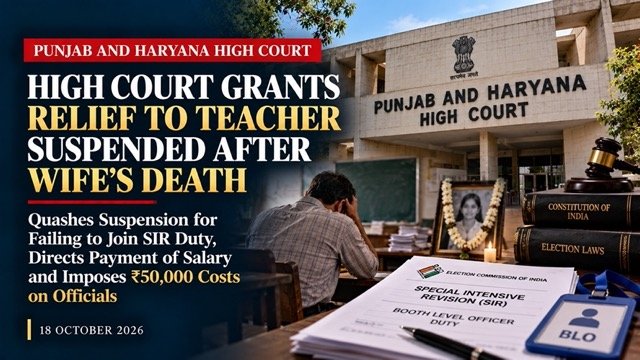
The Punjab and Haryana High Court has quashed the suspension and proposed disciplinary proceedings against a Haryana teacher who failed to join Special Intensive Revision (SIR)-related election duties following the death of his wife. The Court also directed payment of his full salary and allowances for the suspension period and imposed costs of ₹50,000 on the concerned election officials.
The matter was heard by Justice Harpreet Singh Brar.
Background of the Case
The teacher, Sunil Kumar, had reportedly served as a Booth Level Officer (BLO) for around 11 years. Following the death of his wife in September 2025, he was left to care for his children and his 83-year-old mother.
Kumar had sought relief from his assigned duties through the proper administrative channel. However, despite the appointment of substitute BLOs, the replacements did not join, and disciplinary action was initiated against him for failing to perform the assigned work.
High Court’s Decision
Taking into account the circumstances surrounding the teacher’s absence, the High Court set aside his suspension and the proposed disciplinary proceedings. It further directed the authorities to release his full salary and allowances for the suspension period.
The Court also imposed ₹50,000 in costs on the concerned election authorities, including the District Election Officer, Hisar, and the Electoral Registration Officer/Sub-Divisional Officer, Barwala.
The ruling highlighted the importance of administrative accountability and the need to consider employees’ genuine personal circumstances while assigning election-related responsibilities.
Why the Judgment Matters
The decision underscores that administrative action must be fair, proportionate and sensitive to the facts of each case. While election duties are an important public responsibility, the circumstances of an employee facing a serious family crisis may warrant appropriate consideration by the authorities.
The case also raises questions about administrative coordination, particularly where substitute personnel have been appointed but fail to report for duty.
Conclusion
The Punjab and Haryana High Court’s decision provides relief to the teacher and reinforces the principle that disciplinary action should not be considered in isolation from the circumstances that led to the alleged failure to perform official duties.
The ruling serves as a reminder that public administration requires not only compliance with official responsibilities but also fairness, accountability and reasoned decision-making.
LexQore will continue to track important developments from Indian courts and their implications for law and public administration.
Make the legal facts more preciseReduce repetition in the conclusion
Comments
Be the first to comment.