
LEXQORE | Supreme Court of India | October 12, 2026
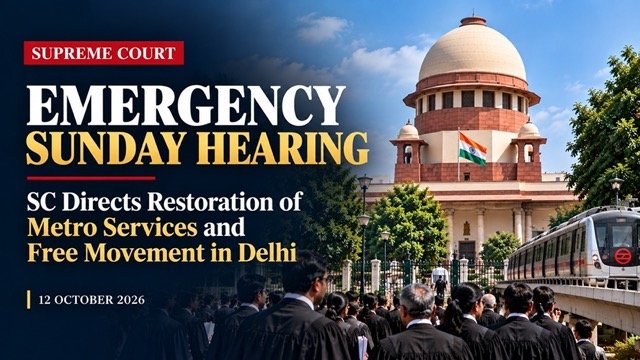
New Delhi: In an extraordinary Sunday sitting on October 11, 2026, the Supreme Court of India issued significant directions to the Union government and Delhi authorities concerning restrictions imposed across the national capital during protests demanding the resignation of Chief Election Commissioner Gyanesh Kumar.
The special Bench comprising Justice Joymalya Bagchi and Justice V. Mohana directed authorities to ensure the normal functioning of Metro and railway services, facilitate the movement of citizens, review unnecessary barricading and prevent unlawful detentions.
The proceedings followed widespread disruption across Delhi on October 10, when extensive security arrangements, preventive detentions and restrictions on public transportation were imposed ahead of demonstrations organised by the Cockroach Janta Party (CJP) and other groups.
Although Chief Justice of India Surya Kant had headed the Bench that examined the restrictions on October 9, the special Sunday hearing was conducted by Justices Bagchi and Mohana. The distinction is important when reporting the judicial proceedings.
Supreme Court Intervenes Amid Widespread Restrictions in Delhi
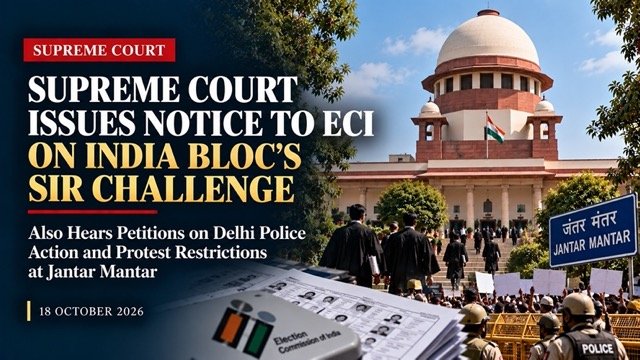
The controversy began after authorities introduced extensive security measures ahead of a proposed demonstration at Jantar Mantar.
The protest was organised amid allegations concerning the functioning of the Election Commission of India and the Special Intensive Revision of electoral rolls.
To prevent large-scale mobilisation, authorities imposed restrictions affecting public transportation, road movement and access to several areas of the capital.
Reports indicated that numerous Metro stations were closed or made inaccessible, railway services were disrupted and thousands of individuals were detained.
The restrictions affected not only protesters but also ordinary commuters, working professionals, students and individuals requiring access to essential services.
The measures prompted urgent legal challenges questioning whether the authorities had exceeded their powers while attempting to maintain public order.
The Supreme Court had already examined the proposed transport restrictions on October 9, directing authorities to distinguish between regulating public transportation and imposing a complete prohibition.
However, allegations of continued disruption and non-compliance with those directions resulted in the special Sunday hearing.
Special Sunday Bench Issues Directions to Authorities
During the hearing on October 11, the Supreme Court considered petitions raising concerns about preventive detentions, disruption of essential services and restrictions on public movement.
The Bench issued several interim directions intended to protect constitutional freedoms while preserving the administration’s authority to maintain public order.
The principal directions included:
- Protection against unlawful detention: Authorities must ensure that no individual is detained except in accordance with the procedure established by law, particularly where peaceful and unarmed assemblies take place outside areas covered by valid prohibitory orders.
- Normal Metro and railway operations: Metro and railway services must function normally unless restrictions are necessary to address a genuine public-order situation.
- Free movement of citizens: Residents must be permitted to move freely throughout Delhi, subject to lawful traffic regulations.
- Review of barricades: Authorities must immediately reconsider barricading arrangements in light of prevailing traffic and law-and-order conditions.
- Internet connectivity: Internet services must remain undisturbed, subject to restrictions lawfully imposed under applicable legislation.
- Access to courts: Authorities were directed to remove notices concerning prohibitory orders around the Supreme Court, if not already removed, to prevent interference with access to judicial institutions.
These directions were intended to prevent unnecessary interference with ordinary civic life while recognising that lawful and proportionate restrictions may be imposed where public safety requires them.
Supreme Court Questions Blanket Restrictions on Public Transportation
One of the central issues before the Court concerned the extensive disruption of Metro and railway services.
The Court had previously expressed concern that the authorities’ response to a proposed protest could inconvenience thousands of individuals who had no connection with the demonstration.
During the October 9 proceedings, the Bench headed by CJI Surya Kant had examined communications concerning the closure of Metro station gates and restrictions on railway operations.
The Court observed that authorities must distinguish between regulating transport services and completely prohibiting their operation.
It consequently directed that Metro and railway services be permitted to function in a suitably regulated manner, with adequate public communication regarding restrictions.
Despite these directions, allegations emerged that transport services remained substantially disrupted on October 10.
During the special Sunday hearing, the Bench reiterated the importance of maintaining normal transportation services unless restrictions were legally justified by public-order considerations.
The directions reinforced the principle that administrative measures intended to prevent disturbances should not unnecessarily disrupt the lives of ordinary citizens.
Court Emphasises Protection Against Illegal Detentions
The detention of protesters and other individuals during the security operation became another significant issue before the Supreme Court.
Petitioners raised concerns regarding the legal basis for preventive detentions and the treatment of individuals participating in peaceful demonstrations.
The Bench clarified that detention must comply with the procedure established by law.
Particular emphasis was placed on peaceful and unarmed gatherings taking place outside areas where prohibitory orders under Section 163 of the Bharatiya Nagarik Suraksha Sanhita, 2023, were operative.
The Court’s directions did not create an unrestricted right to protest at any location or prevent authorities from taking lawful action where public order was genuinely threatened.
Instead, they reaffirmed that preventive policing must remain within the limits prescribed by law.
The directions also underscored the importance of distinguishing between legitimate preventive measures and arbitrary restrictions on personal liberty.
Constitutional Significance of the Supreme Court’s Intervention
The proceedings have brought renewed attention to the constitutional relationship between individual freedoms and the State’s responsibility to maintain public order.
Article 19(1)(a) of the Constitution guarantees freedom of speech and expression, while Article 19(1)(b) protects the right of citizens to assemble peacefully and without arms.
Similarly, Article 19(1)(d) guarantees the right to move freely throughout the territory of India.
These rights are subject to constitutionally permissible restrictions, including those relating to public order.
The Supreme Court’s intervention reflects the importance of ensuring that restrictions imposed by public authorities satisfy the requirements of legality, necessity and proportionality.
While authorities possess statutory powers to prevent disturbances, the exercise of those powers remains subject to judicial scrutiny.
The case also highlights the relevance of Article 21, which protects life and personal liberty and requires that deprivation of personal liberty follow a legally established procedure consistent with constitutional safeguards.
The Court’s directions therefore carry significance beyond the immediate controversy, particularly in relation to the exercise of preventive police powers during public demonstrations.
Section 163 BNSS and the Limits of Preventive Restrictions
Section 163 of the Bharatiya Nagarik Suraksha Sanhita, 2023, empowers designated executive magistrates to issue urgent orders in circumstances involving apprehended danger, nuisance or threats to public tranquillity.
Such orders may restrict certain activities where immediate preventive measures are considered necessary.
However, the existence of these statutory powers does not automatically justify unrestricted limitations on public movement or peaceful assembly throughout an entire city.
The legality of any restriction depends on the circumstances, the scope of the order and compliance with constitutional requirements.
During the Sunday proceedings, the Supreme Court specifically addressed the distinction between gatherings within areas covered by prohibitory orders and peaceful assemblies taking place outside those areas.
The Bench also directed the removal of prohibitory-order notices around the Supreme Court, if they had not already been removed, to safeguard access to judicial institutions.
This aspect of the proceedings emphasised that public-order measures must not unnecessarily obstruct access to courts or the administration of justice.
Contempt Proceedings and Alleged Non-Compliance
The special hearing also involved allegations that authorities had failed to comply with the Supreme Court’s earlier directions concerning transportation restrictions.
The October 9 order had required authorities to reconsider blanket prohibitions and permit regulated operations of Metro and railway services.
Subsequent petitions alleged that restrictions imposed on October 10 were inconsistent with those directions.
The Supreme Court issued notices in the contempt proceedings to the concerned authorities, including the Delhi Metro Rail Corporation, railway officials and Delhi Police.
However, the issuance of notice does not amount to a judicial finding that contempt has been committed.
The allegations remain subject to consideration after the concerned authorities have had an opportunity to respond.
The Court’s approach reflects the distinction between issuing immediate protective directions and determining responsibility for alleged violations of earlier judicial orders.
Judicial Oversight During Public-Order Emergencies
The extraordinary Sunday sitting demonstrates the judiciary’s role in examining urgent allegations involving restrictions on fundamental rights.
The proceedings addressed concerns extending beyond the immediate interests of political protesters.
Restrictions on transportation, internet connectivity, road access and movement can affect individuals who are not participating in demonstrations.
Consequently, the Court’s intervention focused on ensuring that administrative responses to public-order concerns did not impose disproportionate burdens on the wider population.
At the same time, the Bench acknowledged that authorities retain the power to impose restrictions where justified by prevailing law-and-order conditions.
The directions therefore sought to maintain a balance between constitutional freedoms and legitimate public-safety requirements.
Conclusion
The Supreme Court’s special Sunday hearing on October 11, 2026, represents a significant judicial intervention concerning restrictions imposed during protests in the national capital.
By directing the normal functioning of Metro and railway services, protecting lawful movement, requiring the review of barricades and reiterating safeguards against illegal detention, the Court emphasised the constitutional limits governing preventive police action.
The proceedings also highlighted the importance of compliance with judicial directions and the availability of urgent judicial remedies when fundamental rights are allegedly threatened.
While the authorities retain responsibility for maintaining public order, their powers must be exercised within the framework of constitutional protections and established legal procedures.
The central legal principle emerging from the proceedings is that maintaining public order and protecting fundamental rights are complementary constitutional responsibilities, not mutually exclusive objectives.
The pending proceedings and responses from the concerned authorities will remain important in determining whether the restrictions imposed during the protests complied with the law.
LEXQORE | Legal News & Analysis
Published: October 12, 2026
Court: Supreme Court of India
Category: Constitutional Law | Fundamental Rights | Public Interest
Comments
Be the first to comment.