
LexQore | Legal News | October 18, 2026
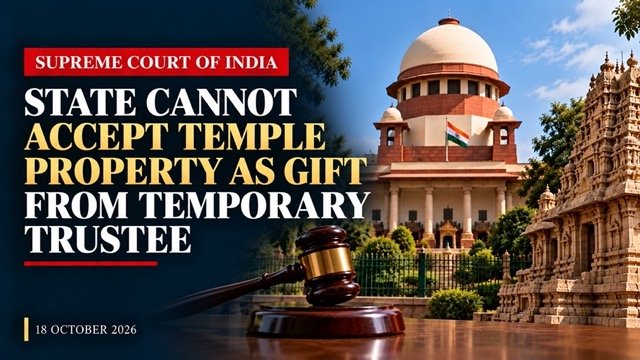
The Supreme Court of India has ruled that a State Government cannot accept temple property as a gift from a temporary trustee when the transfer violates statutory protections governing religious endowments. The Court clarified that the State acts as a custodian and regulator of temple property, not its owner, and cannot take over such property in the name of public interest or administrative convenience.
The ruling was delivered by a Bench of Justice P.S. Narasimha and Justice Alok Aradhe in K. Ramalingam and Others v. Government of Tamil Nadu and Others, on October 16, 2026.
Background of the Case
The dispute concerned approximately 1 acre and 10 cents of land belonging to the Nagapalayam Mariamman-Ponnachiamman Temple in Kodumudi village, Erode district, Tamil Nadu.
On August 30, 2017, a temporary trustee, S. Bhoopathy, executed a gift deed transferring the temple land to the Tamil Nadu Government for the construction of a Taluk Office. The gift was accepted by the local revenue authorities.
The transfer was challenged by devotees and the temple’s hereditary trustee, who argued that the trustee lacked the legal authority to gift temple property and that the transaction violated the Tamil Nadu Hindu Religious and Charitable Endowments Act, 1959.
Although the Madras High Court had earlier dismissed the challenge, the matter subsequently reached the Supreme Court.
Supreme Court’s Key Findings
The Supreme Court set aside the High Court’s decision and declared the gift deed null and void.
The Bench emphasised that property dedicated to a deity is held for the deity and the worshipping community. Trustees are responsible for protecting and managing such property in accordance with the law; their position does not confer unrestricted power to dispose of it.
The Court examined Section 41 of the Tamil Nadu Hindu Religious and Charitable Endowments Act, 1959, which prohibits gifts of certain inam lands granted for the support or maintenance of religious institutions. It held that the gift in question was void from the outset and could not be validated through subsequent approval.
The Court also considered the restrictions under Section 22-A of the Registration Act, 1908, as applicable in Tamil Nadu.
Public Purpose Cannot Override Legal Restrictions
The State argued that a Taluk Office had already been constructed on the land using public funds and served a genuine public need.
The Supreme Court nevertheless held that the public purpose behind the transfer could not cure a transaction prohibited by law. It made clear that the Government’s responsibility to regulate and protect temple properties does not entitle it to acquire ownership through an unlawful gift.
The judgment reinforces the principle that administrative convenience cannot override statutory safeguards governing religious and charitable institutions.
Government Directed to Pay Rent and Costs
While declaring the gift deed invalid, the Court addressed the Government’s continued use of the land for the Taluk Office.
The State was directed to pay monthly rent of ₹31,000, retrospectively from March 8, 2019, along with outstanding arrears, within three months. The temple trust will retain authority over the lease period, renewal and other conditions in accordance with the applicable law. The rent must be reviewed every three years and cannot be reduced below ₹31,000 per month.
The Court also imposed costs of ₹1 lakh on the Tamil Nadu Government, payable to the temple.
Legal Significance of the Judgment
The ruling is significant for the administration of religious and charitable endowments across Tamil Nadu. It reinforces the distinction between the State’s regulatory role and ownership of institutional property.
It also underscores that trustees must act in the interests of the religious institution and cannot treat temple land as property available for gratuitous transfer. Where a statute expressly prohibits a transaction, neither a public-purpose justification nor administrative approval can make that transaction lawful.
The judgment further highlights the importance of accountability when government authorities accept or use property in violation of statutory safeguards.
Conclusion
The Supreme Court’s decision in K. Ramalingam reaffirms that temple property cannot be gifted away in disregard of the law, even when the intended recipient is the State Government and the proposed use serves a public purpose.
By invalidating the gift deed, directing payment of rent and imposing costs, the Court has reinforced the legal duty of both trustees and public authorities to protect religious endowment property.
LexQore will continue to track important Supreme Court judgments and their implications for property law, religious endowments and public administration.
Comments
Be the first to comment.