
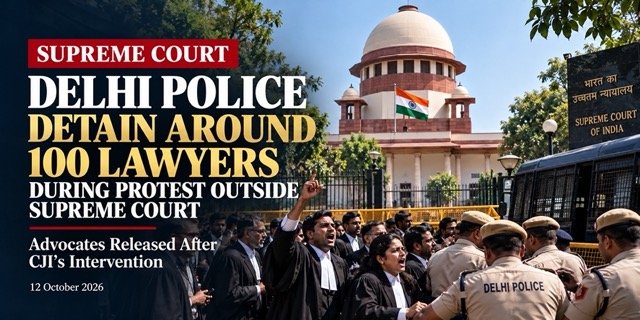
New Delhi, October 12, 2026: Around 100 lawyers, including Supreme Court Advocates-on-Record (AoRs), were detained by the Delhi Police on October 10 while participating in a peaceful protest outside the Supreme Court of India in New Delhi. The detentions took place amid heightened security across the national capital as youth-led demonstrations organised by the Cockroach Janta Party (CJP) demanded the resignation of Chief Election Commissioner Gyanesh Kumar.
The detained legal professionals were reportedly held at the Yamuna Sports Complex for nearly two hours before being released on Saturday evening following the intervention of Chief Justice of India (CJI) Surya Kant and Solicitor General Tushar Mehta.
The incident triggered widespread concern within the legal fraternity, with the Supreme Court Bar Association (SCBA) and the Supreme Court Advocates-on-Record Association (SCAORA) raising objections to the reported use of force against members of the legal profession.
Massive Security Deployment Amid Planned Demonstration
The detentions occurred as Delhi witnessed a sweeping security lockdown ahead of a large-scale protest planned by the CJP under the banner of “Jantar Mantar 2.0”. The demonstration was organised to demand the resignation of Chief Election Commissioner Gyanesh Kumar.
The Delhi Police had denied permission for the proposed gathering, prompting extensive security arrangements across the capital. According to the information provided, approximately 25,000 security personnel were deployed, while 45 metro stations were closed as part of the security measures.
Authorities also carried out preventive detentions at multiple locations to restrict the mobilisation of protesters.
The scale of the restrictions and the detention of legal professionals drew criticism, particularly because the lawyers were reportedly picked up from areas near the Supreme Court and lawyers’ chambers.
Advocates Allegedly Dragged Into Police Vehicles
Among those detained were Ratna Singh, head of the CJP’s legal team, and Supreme Court Advocate-on-Record Sumita Hazarika.
Reports and videos circulating online allegedly showed police personnel dragging advocates and forcibly placing them into police vehicles. The footage intensified criticism of the police action and raised questions about the treatment of legal professionals participating in a protest.
The reported detentions of practising advocates, including lawyers associated with the Supreme Court, became a major point of concern for members of the legal community.
The incident also brought renewed attention to the balance between maintaining public order and protecting the rights of citizens and legal professionals to participate in peaceful demonstrations.
SCBA and SCAORA Seek Urgent Intervention
The detention of lawyers prompted an immediate response from the legal fraternity. The Supreme Court Bar Association and the Supreme Court Advocates-on-Record Association reportedly passed emergency resolutions condemning what they described as the excessive use of force by the Delhi Police.
The associations formally approached Chief Justice of India Surya Kant, seeking urgent intervention in the matter.
The representations highlighted concerns over the reported manner in which advocates were detained and the broader implications of such police action for the independence and functioning of the legal profession.
Following the intervention of CJI Surya Kant and Solicitor General Tushar Mehta, the detained advocates were released from the Yamuna Sports Complex on Saturday evening.
Their release brought an end to the immediate detention episode, although questions surrounding the police operation and the restrictions imposed across Delhi remained unresolved.
CJP Leaders Also Detained at Delhi Airport
The police action extended beyond the lawyers protesting near the Supreme Court. CJP founder Abhijeet Dipke and senior party leaders Saurav Das and Ashutosh Ranka were reportedly detained at Delhi Airport after arriving from Mumbai aboard a commercial aircraft.
Their detention formed part of the broader preventive action taken ahead of the planned demonstration.
The detention of political organisers alongside legal professionals underscored the extent of the security measures surrounding the proposed “Jantar Mantar 2.0” protest.
The developments also intensified tensions between the protesting group and the authorities, leading to further street demonstrations and calls for judicial scrutiny of the restrictions.
Supreme Court Holds Special Sunday Hearing
The controversy continued on October 11, when the Supreme Court of India reportedly convened a special Sunday hearing to address the sweeping restrictions and lockdown measures imposed across Delhi.
The hearing came amid growing concern over the scale of the security arrangements and the detention of individuals associated with the planned protest.
Separately, following a court order issued on Sunday, CJP leaders Abhijeet Dipke, Saurav Das and Ashutosh Ranka were also released from executive custody.
The developments marked a significant turn in the episode, with judicial intervention playing a central role in securing the release of both the detained advocates and the CJP leadership.
Questions Over Protest Rights and Police Powers
The events of October 10 and 11 have brought the relationship between public order, protest rights and police powers into focus.
While authorities may impose security restrictions to prevent violence and maintain public order, the reported detention of lawyers near the Supreme Court and the alleged use of force have raised concerns about the proportionality of the measures adopted.
The involvement of the SCBA, SCAORA and the Chief Justice of India also highlights the importance of institutional safeguards when members of the legal profession face alleged coercive action by law enforcement agencies.
At the same time, the circumstances surrounding the police operation, the legal basis for individual detentions and the justification for the extensive restrictions remain matters requiring careful examination.
Conclusion
The detention of around 100 lawyers during the CJP-led protest has developed into a significant confrontation involving the Delhi Police, political organisers and the legal fraternity. The subsequent release of the advocates following intervention by senior judicial and government law officers, followed by the release of CJP leaders after a separate court order, has brought immediate relief to those detained.
However, the episode leaves important questions about the limits of preventive policing, the protection of peaceful assembly and the proportionality of large-scale security restrictions.
As the matter continues to draw attention, the focus is likely to remain on ensuring that public order measures are implemented lawfully and that fundamental rights and the independence of the legal profession are adequately protected.
Editorial note: This article is based on the information supplied. The reported detentions, police actions, court proceedings and statements should be independently verified against reliable news reports, official police statements and relevant court records before publication.
Comments
Be the first to comment.