
LEXQORE | Legal News
October 16, 2026 | Meerut, Uttar Pradesh
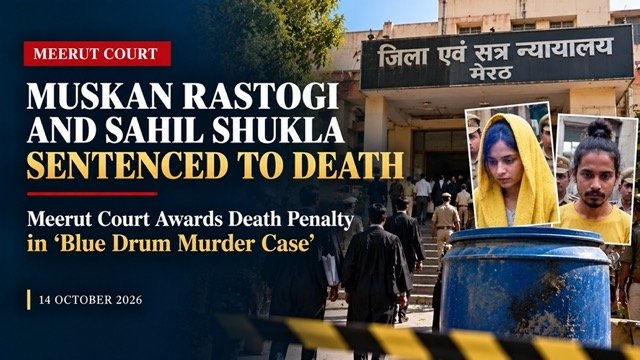
A district court in Meerut sentenced Muskan Rastogi, 26, and Sahil Shukla, 28, to death on October 14, 2026, for the murder of Saurabh Rajput, Rastogi’s husband and a former Merchant Navy officer. The case, widely known as the “Blue Drum Murder Case,” attracted nationwide attention after Rajput’s dismembered remains were discovered concealed inside a blue plastic drum filled with cement and sand.
District and Sessions Judge Arvind Kumar Mishra pronounced the sentences after the court had convicted both accused on September 30, 2026, of murder and destruction of evidence. The sentencing marks the conclusion of the trial at the district-court level, although further judicial proceedings remain possible.
Background of the Case
According to reports based on the prosecution’s case, Rajput was killed in Meerut in March 2025. Investigators alleged that Rastogi and Shukla conspired to murder him and subsequently concealed his remains inside a drum at the residence.
The case came to light after Rajput’s disappearance prompted inquiries. His remains were reportedly recovered approximately two weeks after the killing. The unusual method used to conceal the body became a defining feature of the investigation and brought the case into the national spotlight.
Evidence and Trial Proceedings
The trial involved 126 hearings and testimony from 22 prosecution witnesses, according to media reports. The prosecution relied on a combination of documentary, forensic and circumstantial evidence to establish its case.
Reports state that the police chargesheet included forensic findings, call detail records, CCTV footage and witness statements. Investigators also recorded statements from individuals connected with the alleged purchase of items and the accused persons’ movements after the incident. The prosecution maintained that the evidence established the involvement of both accused despite the absence of a direct eyewitness to the killing.
The court convicted the two on September 30 and subsequently heard submissions on the appropriate sentence. The prosecution sought capital punishment, arguing that the circumstances warranted the maximum penalty. The defence, meanwhile, sought leniency, reportedly citing the future and upbringing of Rastogi’s children.
Why Did the Court Award the Death Penalty?
The prosecution argued that the nature of the murder, the concealment of the remains and the destruction of evidence justified the death sentence under the “rarest of rare” doctrine governing capital punishment in India.
According to reporting quoting the prosecution’s lawyer, the judge referred to the Mahabharata while discussing the principle that punishment should correspond to the gravity of the crime. The death sentences were accompanied by financial penalties, as reported by the media.
Under Indian sentencing law, the death penalty is reserved for exceptional cases and requires a reasoned judicial decision. The prosecution’s demand for capital punishment does not itself determine the outcome; the court must independently assess the facts, aggravating and mitigating circumstances, and applicable legal principles.
What Happens Next Under the Law?
The death sentences are not automatically executable following the trial court’s decision. Under Section 366 of the Code of Criminal Procedure, 1973, a death sentence passed by a Sessions Court must be submitted to the High Court for confirmation. The High Court may confirm the sentence, pass another sentence authorised by law, annul the conviction, convict the accused of another offence, or order a new trial, as permitted by law.
The convicts may also challenge their convictions and sentences through the applicable appellate process. Any further appeal or review will depend on the proceedings and decisions of the higher courts.
Conclusion
The Meerut verdict has brought the district-court trial in the Blue Drum Murder Case to a significant stage. The case highlights the role of forensic and circumstantial evidence in serious criminal prosecutions, as well as the demanding legal standard that must be met before a death sentence can ultimately be carried out.
The final legal outcome will depend on the High Court’s confirmation proceedings and any subsequent challenges available to the convicts.
LEXQORE | Legal News


Comments
Be the first to comment.